
Garden Tool Maintenance: Cleaning, Oiling & Sharpening
16/11/2025
Garden Tool Maintenance: Cleaning, Oiling & Sharpening
A practical guide to garden tool maintenance—how to clean, protect from rust, and sharpen pruners, grafting knives and other blades. Includes tips for Swiss-made GARD sharpeners and Japanese whetstones.
Why maintenance is the cheapest upgrade
Most garden tools don’t fail from “hard work”—they fail from moisture, sticky sap/resin, and neglected sharpening. A simple routine:
- improves cutting performance (less tearing, cleaner cuts),
- reduces effort while working,
- extends tool life,
- helps prevent rust and “stiff” joints.
The 5-minute routine after every gardening session
- Wipe off dirt and moisture:
Remove soil, plant residue and water with a dry cloth. - Remove sap and resin:
Especially important for pruners and knives. Use alcohol wipes or a mild cleaner—then dry the tool. - Add a drop of oil to moving parts:
For pruners: the pivot/bolt area and spring zone. Wipe away excess. - Quick check:
Loose bolt? Blade nicked? Stiff movement? Fixing small issues early saves time later. - Store dry:
Don’t leave tools on damp floors, in a humid greenhouse, or in an unventilated shed.
Rust prevention (without overcomplicating it)
- Never store tools wet. Even one night can create rust spots.
- Hang tools on hooks or store them so blades don’t touch damp surfaces.
- If light rust appears: gently remove it with a fine abrasive pad, wipe clean, then apply a thin oil film.
When should you sharpen? (simple signs)
- You need noticeably more force than usual.
- The blade crushes/tears plant tissue instead of slicing.
- You can see a shiny flat “rounded” section along the edge.
- A grafting knife “slides” rather than bites cleanly.
Tip: Sharpening works best when you do it often and lightly, not rarely and aggressively.
Sharpening options: Swiss sharpeners vs Japanese whetstones
1) Swiss-made GARD sharpeners (Swissistor)
Best for: quick, everyday edge maintenance.
Why people like them: fast, simple, consistent, and easy to keep in the shed.
- Work on a stable surface.
- Keep a consistent angle—don’t change it from stroke to stroke.
- Use light, even strokes (pressure isn’t the goal).
- Wipe the blade clean afterwards and apply a thin oil film.
2) Japanese whetstones (wetstones)
If you want maximum control over the edge geometry (especially for knives and precision tools), a whetstone is hard to beat.
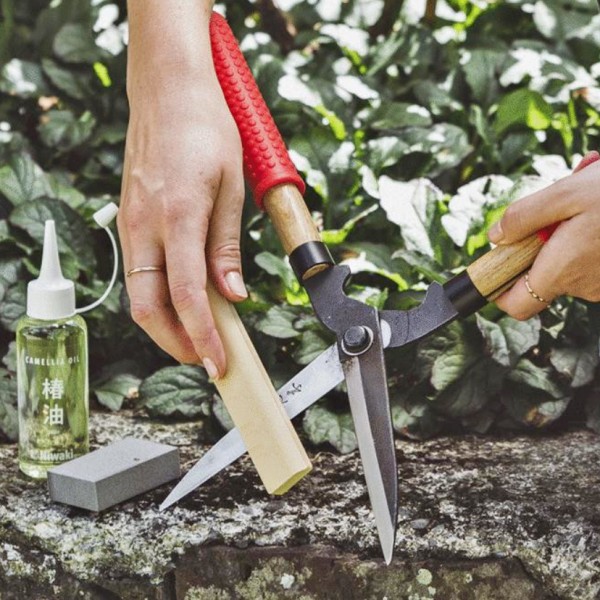
A whetstone is a reliable way to maintain garden blades while keeping full control of the sharpening angle. Instead of removing metal quickly, you can restore sharpness gradually and evenly. For day-to-day upkeep, a few smooth passes are often enough. If a blade has become noticeably dull, a whetstone lets you bring the edge back step by step.
Tip: In most cases you’ll work with the stone wet (with water) rather than dry, and the key is keeping a steady angle throughout. Always follow the specific stone’s instructions from the seller/manufacturer.
Practical example: Japanese double-sided whetstones (like “Amakusa” type stones) are commonly used for garden blades such as sickles, and can also be useful for other cutting tools depending on the edge type.
Pruners (secateurs): the common mistakes
Mistakes:
- Rinsing under water and storing wet.
- Sharpening the wrong side/geometry (many pruners have a primary bevel on one side).
- Ignoring the pivot—an edge can be sharp, but the tool still feels bad if the joint is dirty or dry.
Better approach:
- Remove sap/resin after use
- Oil the pivot
- Sharpen little and often
- Check bolt tension so the blades don’t wobble
Grafting knives & garden knives: precision matters
For grafting and clean pruning cuts, edge quality is critical—torn cuts heal worse.
- Sharpeners for fast touch-ups (great before/after work)
- Whetstones when you want a finer, more precise finish or need a more thorough refresh
After sharpening:
- Wipe off metal residue
- Dry the tool
- Apply a very light oil film for storage
Seasonal maintenance (1–2 times per year)
- Thorough cleaning
- Check bolts and joints
- Oiling
- Sharpening to a “full restore” edge
- Inspect handles for cracks or splinters
Quick FAQ
Do I always need a whetstone? No. For most people, a quality sharpener is perfect for routine maintenance. Whetstones are ideal when you want more control and a cleaner edge finish.
How often should I sharpen? As often as needed to keep cuts clean—generally frequent light sharpening beats rare heavy sharpening.
What about chips/nicks in the blade? Small nicks can often be improved with careful sharpening. Larger damage may need a more thorough repair or professional service.
Conclusion
If your tools are clean, dry, lightly oiled, and sharpened regularly, they work better and last longer—with very little effort. A good setup is having both:
- A Swiss-made sharpener for quick maintenance
- A Japanese whetstone for controlled, precise sharpening
Recommended next steps (CTA ideas):
- Explore GARD sharpeners (Swiss-made / Swissistor)
- Explore Japanese whetstones (wetstones)
Tags: Garden Tool Maintenance, Gardigen